Showing posts with label john. Show all posts

Monday, December 13, 2021

notes and recollections, week 16, meeting 27

 
semester-end evaluations

Think of these as reviews, with attention to what has been done (this semester), and where your work is headed (next semester).

A copy of your process book should be present (if delivery is awaited from Lulu, be prepared to present pdf of same).

Your presentation is up to you. It will include some mix of :
physical work (on table or wall);
your blog posts;
other material from Google drive (I can create a google meet for the reviews).

A current proposal/statement of your work should be submitted in advance, and print-outs brought in for the three reviewers.

You may prepare a google “slide show” for your presentation. This would be especially useful for those with few or no blog posts.


Wednesday, December 8, 2021

notes and recollections, week 15 meetings 25 and 26

in progress
 

process books
(from syllabus, at seminar canvas page

deliverables (by students)

  1. a body of work and the experience that comes with it, that needn’t be seamlessly packaged together; and
  2. a process book, that documents one’s processes, experiments, trials and errors, changes in approach and thinking.

Your process book documents how you moved from Point A through points B, C and D; what you encountered along the way; what changed; and your understanding and assessment of your own process. Someone looking at your process book, ten years hence, should be able to understand what you did, what your aims, changing aims, and outcomes were. (They’re a gift to someone in the future, including yourself.)

Process books going back some 20 years are contained in the gray archival boxes (and 3-ring binders for earlier years, in the file cabinet in studio area). See the directory of those projects at studio.montserrat.edu/gd/405/index.htm; also available in green three-ring binder on table at right of crit wall.

The process book may (or may not, depending!) be used as a kind of test bed for approaches to bringing aspects of your work together — with a view to next semester.


Thursday, intense

during seminar, and in its aftermath, a few things came up; listed below, in no particular order. (I am grateful for such days.)

substitutions, of images within separate image structures. This related to Brooke’s airplane in sky (in NASA envelope address window)... John showed some Wallace Berman (1926-1976) “verifax” (early photocopying method) collages, involving a transistor radio.
examples:
here
artnet, and
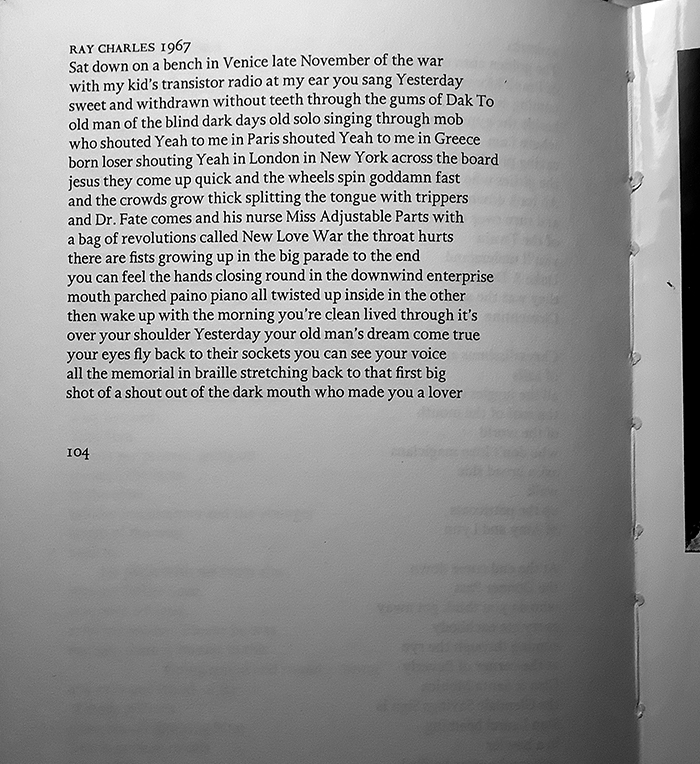
Jack Hirschman’s Black Alephs : Poems 1960-1968 (Phoenix Bookshop in Association with Trigram Press, 1969); I will bring my copy (of this much-loved book) in on Tuesday. Details from one spread (page 104, and facing collage), from my copy, below.

much about Wallace Berman at this Kohn Gallery page, and of course there’s wikipedia.


“A woman needs a man like a fish needs a bicycle”

a phrase to know, and its background to know too —
www.phrases.org.uk/meanings/a-woman-needs-a-man-like-a-fish-needs-a-bicycle.html


“Mess is why we’re here.” (Eimear McBride)...

The reader of Girl has no cover. There is nowhere for her or him to go other than inside the narrator’s thoughts. The Lesser Bohemians is suggesting on the other hand that in order to survive, you must be more than one. Unlike the continuous present of Girl, the protagonists of The Lesser Bohemians arrive at something like a moment of truth when ‘The past sits forward and the cold comes pouring in.’ They have each been warding off this moment for their own reasons but it marks the shift between the casual sex they had been enjoying and not enjoying up until then, and their full-blown love affair. This, we could say, is the unconscious contract between them (as indeed between many couples). It is what they have been gearing up for – and what the reader has been primed to expect – from the start: ‘Mess is why we’re here.’ ‘How were you fucked up? Let me count the ways!’

the above from Jacqueline Rose, “From the Inside Out,” being her review of Eimear McBride, The Lesser Bohemians (2016), in the London Review of Books 38:18 (22 September 2016) :
https://www.lrb.co.uk/the-paper/v38/n18/jacqueline-rose/from-the-inside-out (paywall, pdf at seminar google drive)

a review, and two interviews —

The Lesser Bohemians by Eimear McBride review – a brilliant evocation of sex and intimacy
Lara Feigel. The Guardian. 20 September 2016
https://www.theguardian.com/books/2016/sep/02/the-lesser-bohemians-by-eimear-mcbride-review

Eimear McBride: ‘Women are really angry. I feel a deep, burning sense of injustice at the way women are treated’
Lisa Allardice. The Guardian. 24 January 2020
https://www.theguardian.com/books/2020/jan/24/eimear-mcbride-women-are-really-angry

Eimear McBride: ‘Women grapple with shame because we’re held to a higher standard’
Rachel Cooke. The Guardian. 1 August 2021
https://www.theguardian.com/books/2021/aug/01/eimear-mcbride-women-grapple-with-shame-because-were-held-to-a-higher-standard


parents

This Be The Verse
by Philip Larkin

They fuck you up, your mum and dad.
      They may not mean to, but they do.
They fill you with the faults they had
      And add some extra, just for you.

But they were fucked up in their turn
      By fools in old-style hats and coats,
Who half the time were soppy-stern
      And half at one another’s throats.

Man hands on misery to man.
      It deepens like a coastal shelf.
Get out as early as you can,
      And don’t have any kids yourself.

from Collected Poems (Farrar Straus and Giroux, 2001)
Poetry Foundation


the language of flowers

something to know about. came up in discussion of Melissa’s shattered wallpaper collages, with their violets and coneflowers —

violets —
A white violet meant “innocence” while a purple violet would symbolize that the giver's “thoughts were occupied with love” about the recipient.
google

coneflowers —
In the language of flowers, the purple coneflower denotes skill and resilience – strength and health. Echinacea has a long history in...
google

lots at wikipedia, and many elsewheres.


Laurie Anderson, Norton Lectures / Spending the War Without You

All six of Laurie Anderson’s Norton Lectures will be permanently available on the Mahindra Humanities Center website and YouTube channel starting on Wednesday, December 15.

Lecture 1 : The River   (February 10, 2021)
Lecture 2 : The Forest   (March 24, 2021)
Lecture 3 : Rocks   (April 14, 2021)
Lecture 4 : The Road   (October 6, 2021)
Lecture 5 : The City   (November 10, 2021)
Lecture 6 : Birds   (December 8, 2021)
 

Wednesday, December 1, 2021

notes and recollections, week 14 meetings 23 and 24

 
GERVIN PINEDA work on view !

Fall 2021 Senior Thesis Exhibitions / Visual Communication and Design
December 1-4
Reception: Wednesday, December 1, 5-7pm
Montserrat Gallery and Carol Schlosberg Gallery


process books

Lulu printed books are not required (by me, for the first semester of Seminar); however, some may prefer to use that service. See their website to obtain the Design Guide Bundle for your preferred size (it includes InDesign templates and PDF export settings, at
https://www.lulu.com/create/print-books

The process book, in addition to documenting the development of your work over the semester (and from the initial proposal in May last year), can be a way of “rehearsing” (so to speak) ways of bringing disparate elements together. Quick thumbnails are always the fastest way to think through many ideas, however.

The last day of class is 14 December; process books might be submitted on that day; the final final due date is 20 December. If you are producing via lulu and the hard copy has not arrived yet, send me a pdf of the volume, and confirmation that lulu has received your file.


handle with care

Jessica wondered how to bind her antique store cut-out volume... John suggested to leave it essentially as it is now, and install in a box designed/built specifically for it, perhaps incorporating some kind of “book cradle.”

Some books are best experienced slowly, with careful handling and viewing. This volume is one of them. Importantly, it is one unit in a growing array of objects — the walks/maps; the new work in which image and text are broken down/up (collaged) together; even the idea of a store/installation. John pointed to the work of Dan Kelm (alchemist, book artist), and particularly to his Neo Emblemata Nova (2005) that can be viewed at his wide awake garage website :
http://www.danielkelm.com/core/wideawake/3#/galleries/2

—

Thursday, Jessica showed a book (16 pages?), that incorporated handwriting from her notebook, as well as images (carousel horse, from antique store). The handwriting on some pages/spreads was scribble and abstract; it reminded John of David Seymour’s photograph captioned “A girl draws a picture of home in a center for disturbed children, Poland” (1948), here. (The same image is included in the selection of Seymour’s photographs at davidseymour.com/portfolio-photos; see also the wikipedia page for Seymour, who was also known as “Chim”.)


participation art / relational aesthetics

Henry’s map squiggles, and the responses/alterations/insults/desecrations/vandalisms etc etc that he is seeing, brought to mind the idea of "participation art," that is practiced by many, but often tethered to the work of Nicolas Bourriaud and his writings on “relational aesthetics.” See wikipedia for its entry on relational art.

Claire Bishop, ed., Participation (in the Documents on Contemporary Art series; 2006)
NX 46.5 P37 2006

See the work of Katerina Seda, in particular her “It Doesn’t Matter” (2005-07), linked at https://www.katerinaseda.cz/en/
(John will bring in this publication on Thursday; it concerns some memory aids for the artist’s grandmother, and thus might interest Jessica as well).


language

The question of what language might be brought into visual work, and how, has come up frequently, and on Tuesday in relation to work presented by Will and Eileen. Language need not be thought of as an explanatory caption, but in a more poetic or associative way. One might source language from a single place (e.g., one book), or from several. Notes taken by our respective “scribes” in seminar, might provide some language.

and language (source language) can be transformed; am thinking here of the redactions (to her journal page) solicited by Emily.


infrastructure

We recently noticed that there are no overhead utility lines in the Hardie Building (and downtown Beverly) areas, but encountered them down in the Rantoul industrial area (Park and Dane) that Brooke has been walking/photographing.

So what’s up with that ?

undergrounding
“Undergrounding can increase the initial costs of electric power transmission and distribution but may decrease operational costs over the lifetime of the cables.”

utility poles
“Today, underground distribution lines are increasingly used as an alternative to utility poles in residential neighborhoods, due to poles’ perceived ugliness, as well as safety concerns in areas with large amounts of snow or ice build up.”

John believes that telegraph lines were buried in England (and elsewhere) where failure might have large consequences (e.g., signalling for single-track railroads).


infrastructure (more)

The Roman Roads of Britain Visualized as a Subway Map
designed by Sasha Trubetskoy (@sasha_trub)
https://www.openculture.com/2017/08/the-roman-roads-of-britain-visualized-as-a-subway-map.html
high quality (printable) file available via https://sashamaps.net/store/


infrastructure (still more)

Ludwig Mies van der Rohe (German, 1886–1969),
Werkbund Exhibition: Weissenhof-Siedlung, Stuttgart. View from southeast. First building model. October 1925.
Architect: Ludwig Mies van der Rohe (Photography: H. A. Rühl) , 1925
http://www.artnet.com/artists/ludwig-mies-van-der-rohe/werkbund-exhibition-weissenhof-siedlung-stuttgart-aKDvRdR9rrY4ElzN0cXSlA2

mobile home
Peter Garfield (American, b. 1961, Stamford, CT, USA) - Mobile Home (Prairie), 1995
https://workman.tumblr.com/post/669836185439535104/redlipstickresurrected-peter-garfield
 

Friday, November 26, 2021

notes and recollections, week 13 meeting 22

Gervin Pineda work on view !

Fall 2021 Senior Thesis Exhibitions / Visual Communication and Design
December 1-4
Reception: Wednesday, December 1, 5-7pm
Montserrat Gallery and Carol Schlosberg Gallery


believable but true

Thanks to Brooke, for providing the image (“the older trial piece”) that, when cropped at a 3:4 ratio, yielded the above phrase!

discussion of work shown touched on composition, particularly how much design is enough, and/or too much, for small space (e.g., instagram); and also, how many elements are enough/too much.

John was interested in the utility (or futility?) of accumulating “reference materials;” can this action (inaction?) function as a chronic deferral of the crisis of making, with whatever is at hand, until some always-receding point in an imagined future?


redactions

Emily distributed copies of her journal entry for Sunday, March 3, 2019, and invited seminarians to submit their redactions to her. (Emily has explained that she has in mind the kinds of “redactions” one sees in documents released by the government, e.g., as a result of FOIA (Freedom of Information Act) requests)

it occured to John to look up the meaning and etymology of “redact.” The Merriam Webster dictionary provides three senses :

  1. to put in writing : frame
  2. to select or adapt (as by obscuring or removing sensitive information) for publication or release broadly : edit
  3. to obscure or remove (text) from a document prior to publication or release

The third of these senses is closest to Emily’s conception.

See also the (scriptural) sense elaborated in wikipedia, and the senses captured by the online etymology dictionary.

the latter provides these early senses for the word redact —
redact (v.)
late 14c., redacten, “combine in a unity;” c. 1400, “compile, arrange” (laws, codes, etc.); early 15c., “bring into organized form;” from Latin redactus, past participle of redigere "to drive back, force back; bring back; collect, call in; bring down, reduce to a certain state...”

—

and maybe pertinent (or of use), this —

“So writing is the method of using the word as bait: the word fishing for whatever is not word. When this non-word — between the lines — takes the bait, something has been written. Once whatever is between the lines is caught, the word can be tossed away in relief. But that’s where the analogy ends: the non-word, taking the bait, incorporates it. So what saves you is writing absentmindedly.”
ex Clarice Lispector her Água Viva (1973; Stefan Tobler trans, 2012) : 15


abstraction

We discussed Andrea’s presentation of her process book (in process). The process book should enable a future reader to follow the evolution of one’s ideas, through different iterations of the thesis statement and of the work itself. It need not (and indeed, normally will not) show everything, but rather should present a selection of work and sketches, and annotations thereon.

John wondered (again) about the title “abstraction and pattern,” and whether gesture might be included in that equation (or even replace abstraction). In the context of the thesis subtitle (“first thought,” second thought), abstraction seems to me not a first thought, but indeed a second (after the initial gesture, that cannot explain itself).

—

Not directlyl related to these considerations, but definitely involving the nature of abstraction, is this review a current exhibit at MOMA —

“The Wandering Creativity of Sophie Taeuber-Arp”
“The Swiss artist did it all — paintings and puppets, sculpture and tapestry — and was underestimated because of it. At MoMA she joins the major leagues.”
Jason Farago. The New York Times (November 26, 2021)
www.nytimes.com/2021/11/26/arts/design/sophie-taeuber-arp-review-moma-dada.html (paywall)
pdf at seminar's google drive (2.8MB).

Highly recommend this review, which makes some interesting points too about “indifference” (=erasure) of the artist’s cross-cultural influences.

conclusion :
The density of crosses and curves has a clear aim. They’re here in force to establish the artist as a modernist of the first importance — a modernist of MoMA caliber. In this “Living Abstraction” succeeds totally, and Sophie Taeuber-Arp seems almost a self-contained paradigm of this museum’s recent reinvention: an artist who could make abstraction into a high calling, in fine and applied arts equally. She also has her place in a more global museum, where pictures and people shuttle through endless encounters and no abstraction is pure [emphasis, jm].


clutter

a favorite photograph —

Karl Lagerfeld, photographed by Annie Leibovitz, Vogue (September 2018) : source


Wednesday, November 17, 2021

notes and recollections / week 12, meetings 20 + 21

 
Design instructor Maria Galante draws our attention to this (free) webinar, that may be of interest —

Why Type? The Role of Type in Branding.
From brand strategy to sonic branding, learn why typography plays a significant role in your brand development.
Tom Foley (Sr. Type Director, Monotype) and James Fooks-Bale (Sr. Director of Brand, Monotype).
Date/Time: Tuesday, 7 December at 1:00pm
information and register (free) at
https://www.monotype.com/resources/webinars/why-type-role-type-branding


More Bob Gill —
Which color is best?
at garadinervi.tumblr.com
an excellent design/typography-related tumblr.
from @iknowalotofthings (“A collection of modernist kid’s books.”)

Bob Gill, Graphic Designer Who Insisted the Message was the Mission, Dies at 90

obituary of this graphic designer, by Penelope Green, The New York Times (November 17, 2021) : B11 (paywall; pdf at seminar google drive)

Mr. Gill’s poster for Bob Fosse’s 1978 musical, “Dancin’,” is an indelible image for many New Yorkers.


Henry’s interactive maps

What might the instructions be? Where located? (only on walls?) Size. Why large. Why not small, and bound in pads? with a drop box (all boxes the same, for consistency and to suggest that this is all the same project).

alternatives to “Interact with me” —
Complete me
Mess around with me
Dance with me
Collaborate with me
Draw on me
etc.
etc.

There may have been some imbalance between pointilistic maps and others (with more lines or visual information).
Some of the minimalist, unlabeled maps look like maps of constellations.


shaped paintings

this in regard to Andrea’s first grid (of what John was calling a “landscape”-like abstraction) —
Ellsworth Kelly comes to mind. See exhibition catalogue in seminar library, or
do a Google image search, or see
Jason Farago, “Ellsworth Kelly changed the face of art. At 92, he’s still not done” at The Guardian (31 July 2015)

John also mentioned Nicolas de Staël (1914-55; wikipedia), his landscapes and seascapes.


Guswalks

Eileen’s new group of Guswalk photographs prompted a discussion of pairings. Should it be two of the same, or different? Redundant (e.g., both blue), or complementary (formally or conceptually), or the detail in one standing out, because of its juxtaposition with another?

See TokyoMorningDetails.

We also talked about Gus's role in what gets photographed. For example, he might pause to investigate something at a location, that might not initially have drawn Eileen’s attention, and yet, standing there, something might come into view. Thus, a collaboration; some instances involving Gus more than others.


Head in the Cloud

Brooke presented printouts of earlier work, and some collages.

John mentioned Shigeyasu Gushima, his photographs (mostly (or all)) from the cockpit of an airplane.
tumblr (archive view)
shigeyasu-gushima.com


redactions

Emily showed typewritten results of her “redacted” journal pages. These need to be read (as opposed to “looked at”) to be properly engaged with, I think. We talked about how they might be presented in a book. This might involve the typewritten (or typeset) version on one side of a spread, and the full redacted/marked up version on the other. Probably not at actual size (smaller, I think, for the transformation); with the images scaled so that smaller journal pages appear smaller than the larger ones.

The suggestion has been made, several times, that a page of the journal might be selected and provided to others in Seminar, for their own redactions (or other treatments).

It occurred to me that the typewriter, as a poetry-making tool, was seen by some poets as a means to carefully position individual words and phrases anywhere on a page, visually. There had been so-called shaped poetry earlier (even centuries earlier), but some poets began to use the typewriter as a means by which to “score” the reading of their work. Kyle Schlesinger has written about this in his dissertation Letterpress Printing in the Postmodern Era : Poetry, Media, Typography (1995), which is in the seminar room library.

question (John to Emily) :
Have you experimented with reading these post-redaction versions aloud?


COP26

COP26 came up in Tuesday’s discussions.
2021 United Nations Climate Change Conference
wikipedia
summary of results (at The Guardian —
What are the key points of the Glasgow climate pact? Analysis: Cop26 delegates made progress on emissions cuts and climate adaptation but fell short on coal

Greta Thunberg, You can shove your climate crisis up yer arse

Mention this here, because the airplane tie-clip designs that Brooke used in the “hemisphere” collages she showed, and Melissa’s angry/elegant collages/squares/book about women and — even if only indirectly — the sorry state of the world, somehow relate to climate change issues (and other related crises, that I’ll not attempt to list here).

Wondered if Melissa might be developing this work in parallel with feminist and futurist-oriented fiction; Ursula K. LeGuin and Octavia E. Butler come to mind.

I realize now, that even Will’s ruined house, on the beach, relates. A remnant of a lost civilization, and perhaps species.
 

Friday, November 12, 2021

notes and recollections: week 11, meeting 19

some things that came up (and some that didn’t)

erasure poetry

“Blanked verse: the power of erasure poetry”
Poets have been constructing new work by selectively redacting others’ texts for decades, but Instagram and our political moment have spotlit this startling technique
Carol Rumens. The Guardian (12 November 2021)
https://www.theguardian.com/books/2021/nov/12/blanked-verse-the-power-of-erasure-poetry

pleating

“Kyriacos Hadjikyriacou, Pleater”
Spitalfields Life (November 9, 2021)
https://spitalfieldslife.com/2021/11/09/kyriacos-hadjikyriacou-pleater-x/
Rosamanda Pleaters (more, linked within essay)

Pleating is his imaginative world. ‘This one is stars on one side and squares on the other,’ he explained unrolling an elaborately folded piece of cardboard that quivered as if it had a life of its own. ‘I call it ‘Crown Pleat,” he confided to me in a proud conspiratorial whisper. ‘I have never used it yet.’ Kyri finds inspiration for new designs in pantiles, scallop shells and hieroglyphics.... ¶ ...He may serve the capricious world of fashion, but his is the realm of geometry and chemistry. Cardboard, sticks and string are his tools, and steam is the alchemical essence that enables him to work his sorcery upon the cloth, subjecting it to his desire.


“I think with my hands.”

We (or some of us) read two chapters, or essays, in Maya Lin her Boundaries (2000), being “About the Work” and “On Making.”

My purpose in assigning the reading, which I probably should have one several weeks ago, was to see how one artist/designer articulates their process, and the role of making and language (writing, titling) in that process.

“I do not think that we can fully understand how one makes a specific mark upon a page—at some point one has to trust one’s eye, one’s intuition. ¶ My creative process balances analytic study, based very much on research, with, in the end, a purely intuited gesture. It is almost as if after months of thinking I shut that part of my brain down... ¶ But no matter how often I have gone through this process, I am never sure when I am going to find the form. Or, more accurately, when the form is going to find me.” (pages 3:10 and 3:11)


Melissa’s “angry” collage (triggered by inexact cuts, etc.) brought Frank Stella’s ungeometric wall pieces to mind.


A detail of “‘At Sainte Luce!’ [Hoango] [Q#1]” (1998). Credit...2015 Frank Stella/Artists Rights Society (ARS), New York; Hiroko Masuike/The New York Times
illustrating Roberta Smith, “Tracking Frank Stella’s Restless Migrations (From Painting and Beyond),” The New York Times (October 29, 2015)

The flat color graphics, in the new work presented, brought earlier work by Tom Wesselmann and some of the non-information graphic work of Ladislav Sutnar to mind.

and John Chamberlain (realize this only later) —
“Curator Susan Davidson discusses sculptor John Chamberlain’s exploration of diverse materials, ability to work in any scale, and distinct collagist technique” here:
https://youtu.be/ilkFojMgaH4

See also the typographic work of Robert Massin, in particular The Bald Soprano (1965).


Will’s photographs (of his houses, in situ), and particularly those in cemetery and/or with multiple layers, brought to mind the work of lithographer Peter Milton. John mentioned Milton’s series “The Jolly Corner” (named after the Henry James story that was its prompt), and other instances in which the work is tethered to a single story. Let the house write its own (poetic) story.


Hilma af Klint came up in discussion of Andrea’s work. Lots online, including the Guggenheim exhibit, wikipedia, and this Guardian review of an exhibit in London, Hilma af Klint, a painter possessed.


Eileen’s photographs work well in relationship with each other — as pairs, in various sequences, as two-sided objects, and in relationship with words or phrases (and not necessarily profound phrases, at that). In several photos shown on Tuesday, small elements of red stood out and visually rhymed with each other. John thought of isolated, intense patches of color in the paintings of Thomas Eakins, including
Professor Henry A. Rowland (1897) and
Elizabeth at the Piano (1875), both at the Addison Gallery of American Art in Andover.


Jessica’s visualizations of what we've been calling the interior mind of an antique store, continued to transform themselves.


Emily showed redacted scans (printouts) of her journal writing. She contemplates manually typing out the entirety of these pages, and then blacking out the passages she has redacted by hand. John wondered why not just type the non-redacted passages, either precisely or nearly at their original locations on the pages, or deployed in some other way. He also wondered about the marker bleed-through to the other side of the redacted pages, that something might be done with, the objective being transformation of the original material.
 

Tuesday, November 2, 2021

notes and recollections : week 10, meetings 17 and 18

aside —

the magazine diagram (whose new issue 21.5 appeared yesterday) has come up before, in class.

I draw your attention to Significant Objects / 404 Edition 2021, which is described in the editor’s e-mail announcement of diagram thus —

...this semester I’m doing a literary experiment in value and narrative with my undergraduate fiction students. They bought essentially worthless objects (they cost less than $5) at a thrift store and wrote stories about them. We listed each object with the story on ebay for sale. We’re wondering what value, if any, narrative adds to a thing. There are 12 (I wrote one too), and you can read them all by clicking through the website to each individual auction. The winner of the auction gets the object and a signed copy of the story. All auctions will be ending within the week, so if you want to be part of this experiment in literary value, give their stories a read...


design fiction
(thinking of Will’s and Jessica’s projects, in particular)

caught a tweet encouraging attention to Tony Fry. Writing Design Fiction : Relocating a City in Crisis (Bloomsbury, 2021)
publisher’s website
preview here (some pages)


notemaking

nice example (@the.museum.of.loss.and.renewal)

mentioned in class last week —
ink factory visual storytelling (@inkfactorystudio)


think... can’t... (sequencing, for Melissa) —
the discussion focussed not on individual images, but on movement across the pages, from one spread to the next (and back). It is good to think in terms of music, relatively abstract/emotional passages, punctuated by language (in music, this might not involve words per se, but other signals, e.g., significant drum beats, etc.). I thought: A:B, A:B, A:B, C (where “A” is mainly visual, and “B” is “think” or “can’t” in various legibilities; and “C” is perhaps a coda or conclusion or hint that there is more in another book).

What do you think of this map? (for Henry) —
Develop and try a range of questions; test which elicit the more useful/interesting responses.
Put question next to blank piece of paper. Put question next to something whose map-ness is difficult to understand, that would seem to deny it is a map but, on second thought, might be seen to perform map functions in some way.

lines and (catenary) curves (for Brooke) —
work with diagrammatic (from aeronautics book), photographic (e.g., your own photographs, of power lines) and other clean (and less clean) lines and curves, against chaotic or patterned marks that are not lineal.
see @carolinebagenal’s recent embroideries on photocopies (and postcards), including
this (involving Edward Weston, Clouds over Panamints, Death Valley (1939))

second house (considerations for Will) —
Put this house out in the world, visit it from time to time and record what is going on with it.
And continue to take the first house out to different settings, photographically record these.
we looked at photographs of Gregory Crewdson
language, your own or others’ —
maybe worthwhile to be developing sources of language, for use with your images. the language might come from your own writing of course. or elsewhere: found, for example, four results for the word “ruin” Mark Z. Danielewski’s House of Leaves (2000).
something else —
“Remembering enacts a disruption upon memory presenting truths’ impossibility. Memory can only ever be re-constructed as a fiction - truth is elsewhere, giving us the slip. Polonius knew that: by indirections we find directions out. He knew that the way to find the carp of truth was via the bait of falsehood.”
— Hephzibah Rendle-Short: Indirections_1 (2010)
her website

aftermath discussion with Jessica, about indexing —

Index is the central-office switchboard, so to speak, of elements found in (1) walks, (2) “antique store” (actual, as well as Jessica’s photographs and cut out layered artist book version; (3) junk at home (e.g., grandmother’s mixology book).

Index need not be textual only, nor ordered alphabetically. We discussed shape and color indexes (as seen in Tan Lin’s index of Maya Lin’s Topologies (2015) monograph, and the shape index to The Gorgeous Nothings : Emily Dickinson’s Envelope Poems, 2012); we also discussed index rerum, gazeteers, the use of x-y coordinate systems/grids as indexes, etc., etc.

John thought the antique store cut-out book was a kind of model of the mind, or memory; certainly, it was the mind of the antique shop itself, after owner had left for the night. Dreaming itself, lost in itself, rearranging itself. Rather like the human mind.
 

Tuesday, October 26, 2021

notes and recollections : week 9, meetings 15 and 16

On Tuesday, Gervin showed the book version of his Ascenzia story. Please read through the book (photocopies were left on seminar table), and provide your coments/suggestions to Gervin on Thursday.

Will brought in his house. It may be under construction, but also “It is what it is,” and maybe is as finished as it needs to be, to start its own journey. Andrea came up with dramatic (melodramatic?) endings to the house, e.g., a boot, or explosion... John just wants to see it (photographed) in different settings, perhaps in rain and wind, leaves and mud, at Dane Beach, washed down the stream there into the sea...

Andrea showed new abstractions, based on/derived from her photo of grassy plants. The three images were presented in a visualization, that might have been the garage of an exclusive, high-end condominium tower. We discussed how context might affect how they were understood (= meaning). The suggestion was made that Andrea show the same three images in different settings, and consider the results. (This, by the way, is where "design" enters the picture.)

Henry showed a sketch of an additional map, and a rendering not of paths but areas. There was an interesting overlap with the areal, Venn Diagram-like representations of her walks, that Jessica showed. The different opacities and color mixes might relate or suggested something about how memories merge, overwrite each other.

Brooke showed some photographs of the sky/clouds, and four collages incorporating her source language in various ways. These latter (and particularly nos 1, 3 and 4; no 2 was decorative) open up a good path forward.

Eileen showed photographs taken during her walks with Gus. There were daylight and some night views, also some closeups of nature (e.g., leaves). We talked about how these might be deployed in sequences and groups (closeups as punctuation marks, perhaps); talked about Eileen's abstractions in a Design Factory book; and talked about tagging and indexing the photos.


note —
I have added some comments (mainly regarding work shown by Emily and Eileen) to notes and recollections for week 8 (scroll to bottom).


events —

Women’s Rights Are Humans Rights :
International Posters on Gender-based Inequality, Violence, and Discrimination
Virtual Tour, Free, Tuesday TODAY, October 26th from 12 - 2 pm

This exhibition features fine art graphic posters created by both men and women to celebrate and acknowledge the vital role that all citizens play in protecting and promoting human rights while challenging gender inequality and stereotypes, advancing reproductive and sexual rights, protecting women and girls against brutality, and promoting women’s empowerment, education, and participation in society. The posters argue for the empowerment of women, achievement of equality between women and men, and the elimination of discrimination against women and girls.
https://www.cpp.edu/kellogg-gallery/news-and-events/2021-09-24-womensrightsarehumanrightszoom.shtml


Monday, October 25, 2021

elfland

elfland, School and Summer streets, up the hill from Union Square, Somerville (20211023)
May be useful to Will, as he contemplates siting his bamboo house.
 

@stefon_carpino (a recent seminarian) reports that “40% of the population of Iceland still believes in elves. If you go to some of the rural areas, many people build elf houses just like these!”

Note wind turbine for power generation, upper right.

Note how buildings in foreground appear dangerously close to active geological/tectonic fault and/or recent magma flow.
 

Wednesday, October 20, 2021

notes and recollections : week 8, meetings 13 + 14

Will be adding to and tinkering with this post, for several days.

For Thursday, expect to see new work by Brooke, Eileen, Emily and Will, who did not present on Tuesday.


Gervin showed the two robots, now with surface textures. He will continue on with a book (or “zine”) version of his story, and also with 3D printed toy versions of the robots (including packaging). Gervin will consult with MCA Digital Fabrication Studio @mcadigfabstudio (see their linktree) about how best to proceed with this.


Jessica showed some new, layered collages, using her source material (the mixology book, a street map of Liverpool, etc.). We talked about introduction of some other elements, e.g., The Beatles’ “Eleanor Rigby,” about the composition of which is the subject of Paul McCartney, his “Writing ‘Eleanor Rigby,' How one of the Beatles’ greatest songs came to be.” In The New Yorker (October 25, 2021 issue; online date October 18, 2021).

Walks, walking continue to be an armature for the project, that can have its different walks and detours, even cul-de-sacs.

Jessica showed some new, layered collages, using her source material (the mixology book, a street map of Liverpool, etc.). We talked about introduction of some other elements, e.g., The Beatles’ “Eleanor Rigby,” about the composition of which is the subject of Paul McCartney, his “Writing ‘Eleanor Rigby,' How one of the Beatles’ greatest songs came to be.” In The New Yorker (October 25, 2021 issue; online date October 18, 2021).

John mentioned “Alternative Routes: A Conversation with Lauren Elkin,” by Claire-Louise Bennett, in The Paris Review (October 12, 2021). The conversation is not about walking, but riding a bus and the kind of window that experience provides; it is also about living, being in the “really general, in which not everything has to contribute to a specific idea. Elkin authored Flaneuse: Women Walk the City in Paris, New York, Tokyo, Venice and London (2017).

The artist who bought thousands of copies of The Beatles White Album is Rutherford Chang.


Andrea showed new “multiplications“ (I would call them), being cutups and digital (in Photoshop) rearrangements of one of her recent abstract collages. We discussed how what is in the mind, and therefore prompts the work, does not need to somehow visualized in the work; the work can lead one away from the mind, as one follows its own imperatives and opportunities. Andrea’s thesis work as a Part 1 (visual work) and a Part 2 (behavior). In the very beginning (last May), there was only a Part 2.

reiteration —
abstraction and pattern; first thought, second thought.
I am working with these ideas in two realms: (1) visual design; and (2) behavior. I hope my work in the first realm can play a role in my work in the second, both for me and for others, personally and professionally.

We also talked about the suggestion, from at least two of the reviewers, that Andrea incorporate different sorts of source material, or shapes, in the pattern work. John talked about what an initial gesture might look like (e.g., a slightly curved mark on the slate board, curved because that is what our multi-axis machine tool arm/hand allows us to do, naturally).


Henry showed a sketch map of possible new directions for his mapping project (referred to as Henry’s Guide to Beverly during the panel reviews). There was some discussion of ways to involve others in suggesting map-able topics/memes/oddnesses, preposterous and otherwise.

The idea of “particle collisions“ came up — a google image search will yield various representations of these.


Melissa showed new rough collages, and two groups (squares, and rectangles) derived from the imagery in those collages. We discussed the squares as sequences, and how composition within rectangle, may be secondary to composition in time (left to right, but other directions too). Less language is included in the compositions; the greater usage of printed language in the earlier work, may stem simply from the source (Popular Mechanics) and the large amount of language found there (and its nature, having to do with success, making more money, etc.).

The constellation female, bodies, machines, technologies, and the future is seen in two advertising movies we watched —

2022 Genesis GV70 Commercial 01 USA
and the Apple promotional video for the iPhone 13 Pro,
Oh. So. Pro. (scroll down to “Watch Movie.”

Subsequently, John stumbled on this odd and oddly relevant advertisement, for Lexus, on the back cover of Wired Magazine (January 2020, just as Covid-19 was beginning its global spread and mutations.


Emily showed some closer-in views of some of her collages, involving larger details of “ransom note“ letters — “larger“ meaning relative to smaller hand- and type-written words in the background or dancing around/otherwise interacting with the larger forms. We talked about the square croppings, and modularity, where multiple square-shaped details might be selected out of the larger collages (at either low or higher resolutions).


Eileen showed a new group of photographs taken during dog walks. Some of these were evening/night shots, which had a different tone. We talked about different areas of Beverly to explore, along the Bass River, including Gillis Park and Pleasant View Beach (shown here).

In a subsequent exchange, John suggested that one of the virtues of these walks with Gus — in addition to being that they’re not about Gus — is that Gus is somehow a passport to taking photographs of ANYTHING, and no one wonders or suspects. It’s just a young lady, out for a walk with her dog.
 

Wednesday, October 6, 2021

panel reviews, Weds & Thurs, 13-14 October

Wednesday 13 October
reviewers : John Colan, Bernadette Carr, John McVey
6:30 Brooke
7:00 Jessica
7:30 Will
8:00 Henry

Thursday 14 October
reviewers : John Colan, Bernadette Carr, Maria Galante, John McVey
6:30 Andrea
7:00 Eileen
7:30 Melissa
8:00 Emily
8:30 Gervin

location : Design Seminar room, Hardie 309

The panel is invited to review blog posts, and thesis statements, prior to reviews.
Work may be shown on the wall and/or table, as well as via the blog or other presentation on large flat monitor.


Seminar does not meet on Thursday 7 October; however, John McVey will be in the room, and prepared to talk with anyone about their work (or, indeed, anything).
 

Wednesday, September 29, 2021

notes and recollections 5 : 8 + 9

here I will reconstruct some of the discussions of week 5, meetings 8 and 9 (and perhaps some fragments from week 4, so far neglected).


the face, portraits, identity

We talked about the face and how it might relate to identity, and self-identity. Our lines of thought included mirrors (and reflections in water); instagram and social media generally; the blind (and indicators of someone’s identity other than the visual, including voice); ideas of the self (and self-knowledge, which included a glance at the index to William James his Principles of Psychology (1890); physiognomy (”the practice of assessing a person’s character or personality from their outer appearance—especially the face,” wikipedia); prosopagnosia (“from Greek prósōpon, meaning "face", and agnōsía, meaning "non-knowledge", also called face blindness,” wikipedia).

adoption, adoption in literary fiction

The top ten books about adopted children
by Kate Hamer, The Guardian (1 March 2017)
includes Charlotte Brontë’s Jane Eyre (1847) !

And then questions arise, such as : Can we ever really know another? Can we ever know ourselves, other than as fragments of awareness, memory, ideas, allegiances, failures, successes...

The Foundling Museum (in London; opens to about page); instagram

here, and elsewhere during the morning, we saw how an idea or some background motivation (e.g., adoption, or a beloved grandmother’s dementia) can provide the overall “design” or framework in which experimentation and work can proceed.


maps and purpose

what can our map tell us? what do maps discover, uncover, cover up?
why map? how does a map relate to a list? a diagram, an index?

Henry showed a much-cleaned up map, combining several data sets. Two of the defined areas had a blob-like appearance, leading to speculation about how such blobs might move around, shape-shift, perhaps take on a life of their own, untethered to data, or even generating (false?) data to support their mutations. A kind of gerrymandering. Meltable moments came to (this) mind —

“The current climate caught in an Emoji
A melting face: for when a smiley just doesn’t capture a collective malaise or anxiety.”
Anna P. Kambhampaty, The New York Times (September 30, 2021) : D3

here (paywall)
pdf at seminar drive.


retro-futurism, images/fantasies of happy futures, and the costs/aftermaths of those futures

We looked at four or five of Melissa’s collages closely. A model's face, frame/held by two hands (one evidently male)... suggesting control even violence... a phrase about making more money (by whom, whose labor, for whom), and at lower left, fragments of a crossword puzzle (leading to the idea that one might create a word-portrait in the form of a crossword puzzle, each clue something from the subject's life, each answer a keyword)...

Another image, a woman's bare back (part of her face visible too), flayed by collagist addition of a barely legible train.

We talked about how a group of such collages (perhaps but not necessarily uniformly sized, cropped etc) might operate as a kind of sequence, whose elements relate to each other, counter each other, add nuances or facets to the puzzle. Crossword puzzle as a mirror.

Melissa’s project is evolving, now taking on more of a critical, reflective cast. A look at the dystopian dimension of future visions.


the house in Vermont

Will shared some text about Obadiah Nourse and Mads (Madhouse)[ didn't catch the surname ], their investigation of the attic of the house encountered in the wild, its walls turned to flesh, etc.
A shape for the project came into view: something in the form of a prospectus (for a film or other work, to be presented to potential backers, investors), involving (1) overview; (2) one detailed narrative (e.g., a chapter, perhaps of the aforenamed protagists their journal); (3) supporting 2- and 3-D visuals.
 

Saturday, September 18, 2021

notes and recollections 3 : 5

week 3, meeting 5 (16 September 2021)
(notes in progress)


By zooming into details in collages (of Melissa and Eileen), we looked for and found juxtapositions (occasions of potential significance) that might be exploited, and that might not be apparent or pronounced when viewing the larger image alone.

Gervin walked us through showed some storyboard frames, whose images he will eventually be fine tuning in Blender or similar tools. Gervin will provide a one-or-two paragraph précis of the story, footnoted to the images, as if in a pitch to a source of financing.

We interrogated how we use the word randomness, and how its use is a signal of what is not random in a decision.

We talked about Will’s Dutch colonial-style house — the protagonist in his story — and where limits might be brought in to keep his work from an infinite loop of infinite doors into infinite universes.


We continued to think about maps, mapping, walking, getting lost.

John described lingodroids, two robots who must communicate with each other about a new topographic space, using shared starting vocabulary.
Lingodroids were a source of one exercise in a Typography 1 class he has taught.
The lingodroid paper can be found at google drive, file name schulz-etal_ICRA_2011.pdf.
 

Wednesday, September 15, 2021

notes and recollections 3 : 4

(week 3, meeting 4)
 

to everyone :
Please submit updated/revised/overhauled thesis proposals to me (John McVey), via google drive or attached to an e-mail.
I will promptly put them on your respective designers/proposals pages (links at upper right of blog).


We watched Bernar Venet knock over (with a forklift truck) a row of large iron arcs... the idea involving accident, the use of accident in one’s process —
Performance Effondrement (at YouTube)

Venet (whom I would describe as a geometrician, poet, sculptor and conceptualist, in no particular order) is quite articulate in interviews, for example,
A Conversation with Bernar Venet, A Renaissance Artist of the Third Millennium, by Laura Tansini in Sculpture Magazine (May 1, 2004)
artnet
wikipedia

There is a curious mix of precision (about measurements, materials, weight, location) and accident (and a kind of blindness, an inability to predict or forsee) in Venet’s working method.


maps, mapping (and memory)

Henry showed Google maps of downtown Beverly, around the confluence of Cabot, Knowlton and Winter streets. We discussed what these maps showed, and did not show — made visible, and made invisible. Not every business was named (why not?). Some got reviews, some not (why?). And we discussed other kinds of missing information — topographical/geological information; what bsinesses were at these addresses ten, twenty, even 100 years ago. Certainly left out was this location 400+ years ago, before Europeans began to move in. It was suggested that Henry might add his own points of interest to these maps (e.g., bubble gum in the sidewalks!) — is it possible to customize these maps in Google?

We looked at the Beverly City Directory and North Shore Map for the year 1960, at archive.org. Many (72) volumes, going back to 1903, are available via archive.org. (aside : in 1904, 273 Cabot (until two years ago Maria’s Pizza, now Amazing Pizza and More, was a vacant store)

The Beverly History Room at the Beverly Public Library has these directories, maps, other material relating to the (hidden) history of Beverly (hidden, that is, from a Google Map).

Jessica showed routes of her walks, as tracked by the Under Armour app Map My Walk (GPS Walking & Workout Tracker), and her own recall. it was interesting to see the two versions side by side: the clean (presumably "correct") lines of the app, and her hand-drawn lines of the same routes. The interest was both aesthetic (the different qualities of line) and conceptual ("location memory"). Jessica is also noting things observed (birdcages, etc.). We wondered if one's powers of observation change/improve with practice (we assume yes), and began to consider the value of such observations (beyond the immediate pleasure of simply noticing things during a walk). For example, they provide a kind of snapshot of daily (quotidian) life in Beverly, ca September 2021.

Jessica also showed a drawing of an apartment interior, done from memory and then checked against on-site inspection.


patterns, repetition

Andrea is focussing on pattern, pattern and repetition, pattern and variation... what kinds of formal (and other?) variation there might be.

Andrea directed us to and talked about the impact of Lee Krasner’s Untitled, 1949, at MOMA.
We looked at some drawings/weavings done by Anni Albers.

Melissa is working with old issues of Popular Mechanics as found in archive.org and elsewhere, and finding good material in both editorial and advertising with which to address contemporary and future-oriented themes (e.g., climate change, living standards, money/getting rich). Melissa showed a collage made from advertisements in her source material: overwhelming, and yet revealing fascinating juxtapositions and ideas when viewed through a cropping tool.

Eileen will print thumbnails of her snapshot photos, as a starting point. It was in this context that John sketched one possible way of examining/reusing the material.

Examination of the older photos, and even repurposing them in various ways, may (likely) suggest, in addition, avenues for taking new photos.

Emily presented some different kinds of ciphers (Caesar Cipher, Pigpen Cipher) and other substitution codes, as a possible way of proceeding (the specific aim being, to communicate to others, the difficulty some have in reading facial expressions, body language, etc., and also the extra labor that might be expended in processing what to others is just “normal” verbal and gestural communication, but to some involves painstaking deconstruction of coded messages). Emily also returned to her experiments with handwritten words and sentences (repeated) in various ways (collage, etc.). Working with hand (not computer) is important for Emily at this time. We discussed these, and different ways that collaged material might be employed.

John mentioned the work of Nina Katchadourian, specifically her Office Semaphore project (2006)
Interestingly, she categorises that as a Public Project, and does not include it under the heading language/translation

We also considered Hannah Weiner her Code Poems (1982); copy in seminar room, and online here


books mentioned

  1. Norman Brosterman, Inventing Kindergarten (2002), LB 1199 B76 1997
  2. John Cage, Notations (1969), ML 96.4 C33
    pdf at monoskop.org 74.4MB
  3. Theresa Sauer, Notations 21 (2009), MT 35 S28 2009.
  4. Jessica Wynne, Do Not Erase : Mathematicians and Their Chalkboards (2021), publisher’s page; on order at Montserrat’s library

    see also “Where Theory Meets Chalk, Dust Flies : A photo survey of the blackboards of mathematicians.”
    Photographs by Jessica Wynne Text by Dennis Overbye Published Sept. 23, 2019 Updated Sept. 24, 2019 New York Times (September 23, 2019; paywall); pdf at seminar google drive

    see also “Why mathematicians just can’t quit their blackboards : Photographer Jessica Wynne captures the peculiar devotion of academics to working out their problems with chalk”
    Nicola Davis, The Observer (Sunday edition of The Guardian), 12 October 2019, here
     

Thursday, September 9, 2021

notes and recollections, 2:3 (= week 2, meeting 3)

 
overlooked / forgotten / remembered details.

I left on the seminar room table, Maurice van Es, his now will not be with us forever (2015), open to the volume textures of childhood.
These are details from photos in a family album, only of textures (e.g., of a sofa or carpet). The book is described at his website.
See also his instagram @mauricevanes.
Mention this especially relating to Eileen’s project.


opposites, transformations, sides...
relating in particular to Andrea’s work, but potentially to anyone’s.

View of slate, showing transformations of pointing to a that, that is a this when page turned, that suggests the next that, which becomes a this, and so on. The idea here — associational, but maybe logical too — is the notion of “facets,” of anything, ideas, colors (black, white, gray, warm gray cool gray earl gray... coffee...). Simple idea, but executed with some discipline.

This relates to parataxis/hypotaxis (see bottom of earlier blog post); also to reversals (two faces of a coin: George Washington, general and president (one side), slave owner the other... etc etc.


Samuel Beckett (1906-1989) / wikipedia

Two passages came up, the first from Worstward Ho (1983) —

“All of old. Nothing else ever. Ever tried. Ever failed. No matter. Try again. Fail again. Fail better.”

aside — Tiffany Gill used this passage in her design thesis work, seminar blog (Spring 2012)
and something done earlier (same material)

and the poem “What is the Word” which you can find here.


with regard to facets, or words, ideas, meanings... the chapter The Whiteness of the Whale, in Herman Melville’s Moby-Dick or, The Whale (1851) came up. Here it is at:
Internet Archive; and
gutenberg.org

Wednesday, September 8, 2021

notes, week 2 (meeting 2)

notes (draft); this page in progress, but wanted to provide the Google Books / Hathitrust / Internet Archive info first.


searchable scans of books, magazines
came up in discussion of Melissa’s project, and particularly her images from old issues of Popular Mechanics

Google

Advanced Book Search
note that you can specify search terms across one author, one title, or within a date range. You can even search for nonwords (will yield typographic errors, and even results of OCR misreads

Here is the result of one search, John Locke’s Essay Concerning Human Understanding, a later (London, 1877) edition the result of a search for “words” + “error,” yielding “The misuse of words the cause of great errors.”

strengths : fast, good for searches across all texts (without specifying one title or author); thumbnails load extremely fast (and show interesting mis-scans.
shortcomings : poor bibliographic data (metadata); scans are sometimes imperfect.

While we're on the subject of Google Books, here's an Ngram view showing relative frequency of the words “extraterrestrial” and “martian” in the Google Books corpus (which is what it is, so to speak).

Aside —
Probably a good idea to read about what an Ngram actually is, and does. See the Google Ngram info page.
 

Hathitrust

strengths : excellent bibliographic metadata; displays multiple editions (or issues, volumes, years for serials/magazines) in an orderly way; scans have been checked (few or no errors)
shortcomings : pages and thumbnails load relatively slowly.
 

Internet Archive / Wayback Machine

Internet Archive info

Excellent, even for more recent materials, technical documents, even material still copyright protected (for these, one can “borrow” for an hour, then renew); also old instructional films, even Grateful Dead concerts.

strengths : excellent bibliographic metadata; displays multiple editions (or issues, volumes, years for serials/magazines) in an orderly way; scans generally better than found in Google Books
shortcomings : less good for searching words or phrases across some or all volumes (for this, Google can’t be beat); some searches might start with Google, then move to Hathitrust or Internet Archive.

sort findings by “date published”, then click “down” arrow at left, for earliest first.

some results for Popular Mechanics Collection 1902-2016 shown below. A search for Popular Mechanics (but not collection) yields other copies/scans, some in color.
 

There are other searchable scanned book options, for example Gallica in France, and for plain text editions of materials out of copyright, there is always gutenberg.org (aside: the Australian version provides all of Virginia Woolf!). And not discussed here are other options, for materials in Japan or Spain, for example.

Yet another resource — that I have not explored but am told is steadily improving, is the Digital Public Library of America.

But the three tools described above are useful, and become useful in more and more ways, as one becomes familiar with their respective quirks, overlaps, relative strengths and shortcomings.


parataxis, hypotaxis
this may have come up in relation to Eileen’s photographs.

from wikipedia —

“Parataxis roughly translates to ‘arranging side by side’, while hypotaxis translates to "arranging under’. Parataxis omits subordinating conjunctions while hypotaxis utilizes them such as the terms ‘when’, ‘although’, and ‘after’. Parataxis juxtaposes ideas and thoughts, while hypotaxis subordinates ideas to one another and can show both juxtaposition and transition. Because of this, hypotaxis can show relationships of cause and effect, chronology, and comparison.”

Fair enough, but visually, things can be more complicated. Even in paratactical arrangements of two items, which is at left and which at right may matter; even moreso for three — in a triptych — what is at left, right and center will matter a lot. Are the items in the wings, subordinate to or explanatory to what is in the center? Are we to read from left to right?

And for hyptotaxis, what is above, what below? Is a sequence suggested? or hierarchy? And what of combinations of parataxis and hypotaxis? Of image plus image, or image plus text... and so on.

And obviously there are other basic relationships to consider, e.g., size, or the quality of the image (grainy or high resolution; color or black and white; “picture” or diagram; etc., etc.). Also, space between items in whatever arrangement, signifying something missing, or a pause, a missing comma...
 

Monday, September 6, 2021

notes, week 1 (meeting 1)

for Tuesday 7 September —

Have revised thesis proposal where appropriate, taking into account further thinking and our discussion last Thursday;

Be prepared to show something, or discuss new thinking, ideas, findings; and

read and have some thoughts about three items, that were distributed on paper in class, and can be found in the google drive created for Design Seminar) :

  1. The OED (Oxford English Dictionary) entries for design in its verb and noun forms. These entries include definitions and examples of usage for those respective senses; some of these senses are obsolete or quite limited in scope. The question here is, what senses(s) of design are relevant to what you are doing? What are your “designs” — intentions?
  2. Darcey Steinke, her essay “My Stutter Made Me a Better Writer,” in The New York Times (June 6, 2019)
    I prefer its print title “My stutter made me a writer.”
    The bottom line, “stuttering," which might be likened to “stammering” or to struggling in any way to make sense, is ok.
  3. Heinrich von Kleist, “On the gradual completion of thoughts during speech”
    in the Bosch series type specimen book that you have received via e-mail and in hard copy
    the text is only six pages long — pages 11-17 within the pdf document). It has to do with the importance of conversation (with others) to actually figuring out — hearing — what we think. To that conversation I would add materials, clients, developers, printers, colleagues... Both studio and seminar room are where we can model that conversation, to see where it leads (us, individually).
  4. I also handed out (but didn’t put on Drive), Immaculate Heart College Art Department Rules (1965-1968), shown below and worth thinking about.

The same (and some background on Sister Corita Kent) at and via brainpickings


thoughts and afterthoughts, references


  1. primitive futurismo
    for Gervin, Melissa

    Colonel Bleep (1957)
    watch here
    primitive futurismo (inflected by Cold War ideas, too!)


  2. photos, the social photo, the unshared photo
    for Eileen

    John Kramer, Dailies: installation (partial)
    Hallspace Gallery, November, 2005. A project of photographing the Arnold Arboretum every day on the way to work. This wall piece shows every photograph taken.

    Nathan Jurgenson’s book The Social Photo: On Photography and Social Media (2019) is relevant, I think. The short book is longer than it needs to be; a review that is now uploaded to the 405F21 Google Drive gives a quick overview —

    Leah Ollman, “Review: Writing the book on selfies — sociologist reframes social photos,” Los Angeles Times (August 10, 2019)
     
    The question is, what are we doing when we “take” photos? are they always the same thing? are they even “about” the picture?


  3. house, houses
    for Will

    see Tatsuya Tanaka 田中達也, his miniature houses/scenes/art at @tanaka_tatsuya

    may have mentioned this previously — “The Woman Who Invented Forensics Training with Doll Houses,” by Elizabeth Evitts Dickinson, The New Yorker (November 5, 2017) : here (I may have this in print version, stay tuned)

    Ask to look at Georges Perec, Life: A User's Manual (1978, David Bellos, trans, 1987), described at wikipedia, for example —

    One of Perec’s long-standing projects was the description of a Parisian apartment block as it could be seen if the entire facade were removed, exposing every room. Perec was obsessed with lists: such a description would be exhaustive down to the last detail...

    Maybe think about pop-ups of architectural drawings; will show something (from the 1930s) about “Folding drawings of famous tea houses.”
    link (Ursus Books, catalogue description)

    Perhaps let the house — not the agonied residents — be the “protagonist.” Let the residents be visitors, tenants... who leave their marks on the scarred, year-after-year mutating, house.

    Let language (not yours, but from somewhere/someone else, e.g., Emily Dickinson) leak in...

    The word “stanza” means “room” in Italian.

    See Jeremy Rodas, his thesis project “Momento” (Fall 2017, Spring 2018). (Where he mapped cracks and other insults in the walls of the Hardie Building.) There have been some other thesis projects devoted to houses, buildings, rooms. See for example Lana Wheeler her “The Closet” (2012).


  4. map, maps, mapping
    for Henry
     
    A tusk, as map? —
    “A Woolly Mammoth’s Tusks Reveal a Map of Where It Roamed in Life”
    The technique used to reconstruct the animal’s 28-year journey across prehistoric Alaska could solve mysteries about the demise of the elephant-like mammals.
    By Kenneth Chang, New York Times (August 12, 2021) : here (and in the 405F21 Google Drive.

    Paula Scher, Maps (2011), description

    In what different ways are the words “map,” “mapping,” used?
    How many kinds of maps might describe one neighborhood? or even street? What goes on in that neighborhood or street, that doesn’t obviously involve the humans who live there?


  5. retrofuturist imaginings
    for Melissa

    Is there a story or argument these visualizations are supporting? What is it? How far back in memory (history) must we go, to come up with something relevant to the scenarios that may well lie ahead?


  6. streetwear... brand versus style... social media (and keeping some work separate)
    for Brooke

    Being always under surveillance (social media) can have good and less good results. One might self-edit, pre-edit, hold nothing in reserve... be too attuned or even hostage to “likes,” reblogs, etc.

    Important to just make stuff, content, designs. try them on different materials, canvases. experiment (and never stop the experimenting. Let this work feed or leak into the business side, the message side.

    Be willing to kill what you love, says painter Susan Rothenberg in an interview I read yesterday. When everyone said, don’t paint horses, she painted horses. Later, she moved on. This interview, and a more recent review of her posthumous show in Chicago (and later New York) are in the 405F21 Google Drive.

    Liv Varney livvarney.com, @livvarney